

The following is the transcript of my closing editorial from episode 154 of my news podcast The Mind Killer. If you like it, please consider subscribing to the podcast

Healthcare costs too damn much. Everyone knows it, but nobody knows what to do about it. But recently we’ve gotten a great example of how drug prices can come down fantastically in a short amount of time. Specifically, you make consumers pay for it.
The thing about GLP-1 drugs is that most of the time, insurance won’t cover them for weight loss. While GLP-1-induced weight loss tends to improve health and save insurance companies money over the long run, they still tend to view weight loss drugs as elective and thus not covered under most plans.
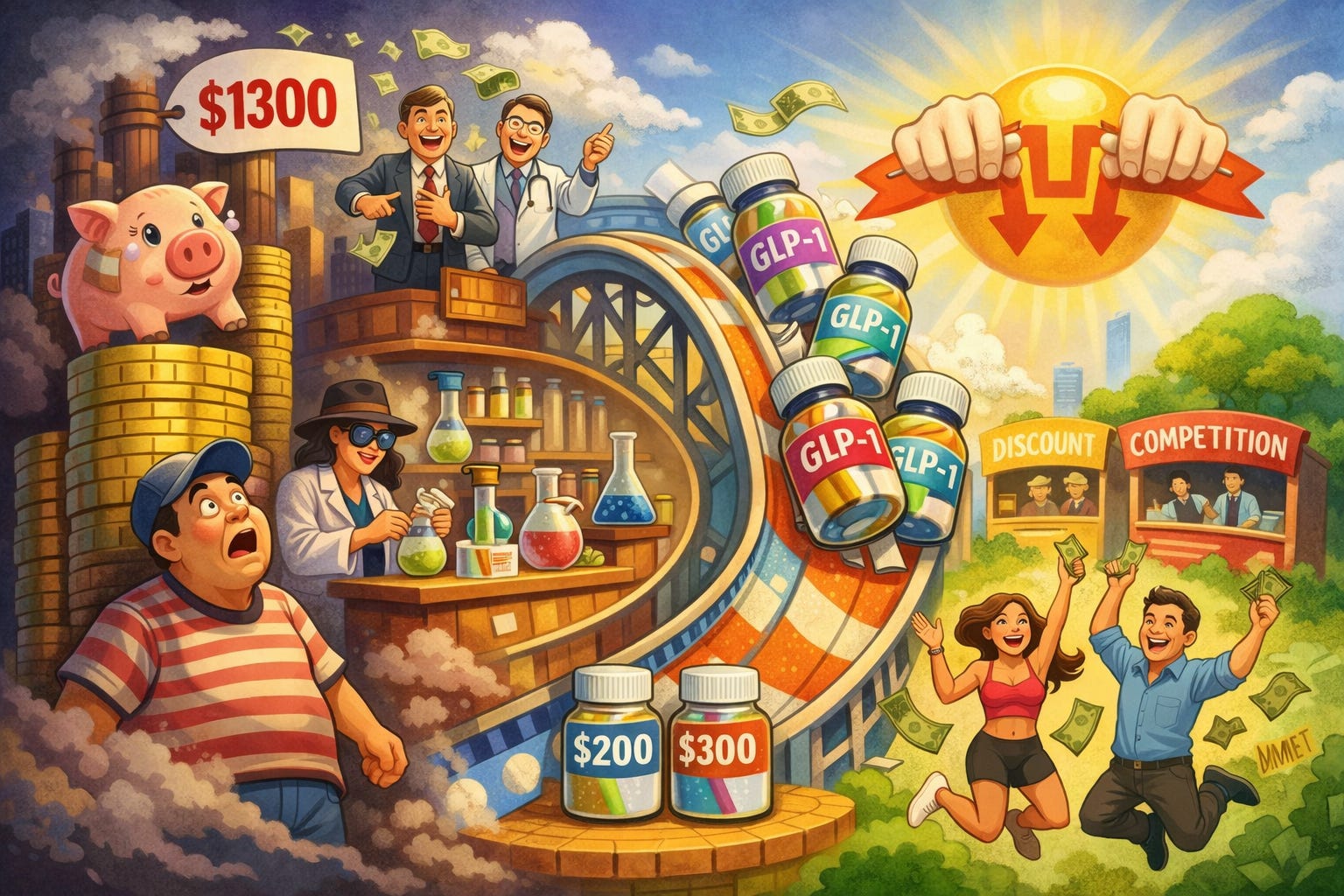
I first got a prescription for semaglutide in 2023, but I didn’t start taking it until 2025 because the price was too high. Novo Nordisk was charging about $1,300 for a one-month supply. I do not have a spare $1,300 to spend every month on what’s mostly a vanity project, and my insurance wouldn’t cover it, so I passed.
Between 2023 and 2025, people caught on that these drugs were basically a silver bullet for weight loss. They got wildly popular, and competitors entered the market. Eli LIlley developed and released Tirzepatide, but that just changed the situation from monopoly to oligopoly, and the price was still out of control. What really changed things is that compounding pharmacies exploited a loophole in the drug patent system which allowed them to make their own drugs and sell them for much cheaper. Gray-market suppliers also started selling peptides “for research purposes” so people could mix their own. Suddenly instead of $1,300 per month, I was able to get a six-month supply for that price. Now the situation is even better, as competition has forced Novo Nordisk and Eli Lilly to lower their prices. They both recently signed a deal with the government to make name-brand Wegovy available for $200/month and Mounjaro for $300/month on trumprx.com (or so they say. I tried to check and the site refuses to load). That’s less than ⅙ of the cost I was quoted 3 years ago. The invisible hand of the market worked out to benefit the consumer yet again!
The reason this doesn’t happen with other health-related goods and services is that consumers never pay for them. Insurers do. And insurers aren’t the ones making the purchasing decision. So you get into the situation where the consumers of healthcare don’t really care what it costs, and can’t find out even if they do care. So prices stay mysterious, consumers are extremely price-insensitive, and costs keep increasing.
The GLP-1 situation shows us that there is nothing magical about healthcare which exempts it from normal market dynamics. If consumers are charged a legible price for it, they will do the normal consumer thing, comparison shop, and generally follow a demand curve. This probably doesn’t apply to life-or-death medical care, but let’s be real, most healthcare spending is not life-or-death. So if we want to lower costs, we need to end the system where the person making the purchasing decision isn’t the same person paying the cost. I’m not sure exactly how to do that, but I’m sure the eggheads could figure it out if they really tried.